
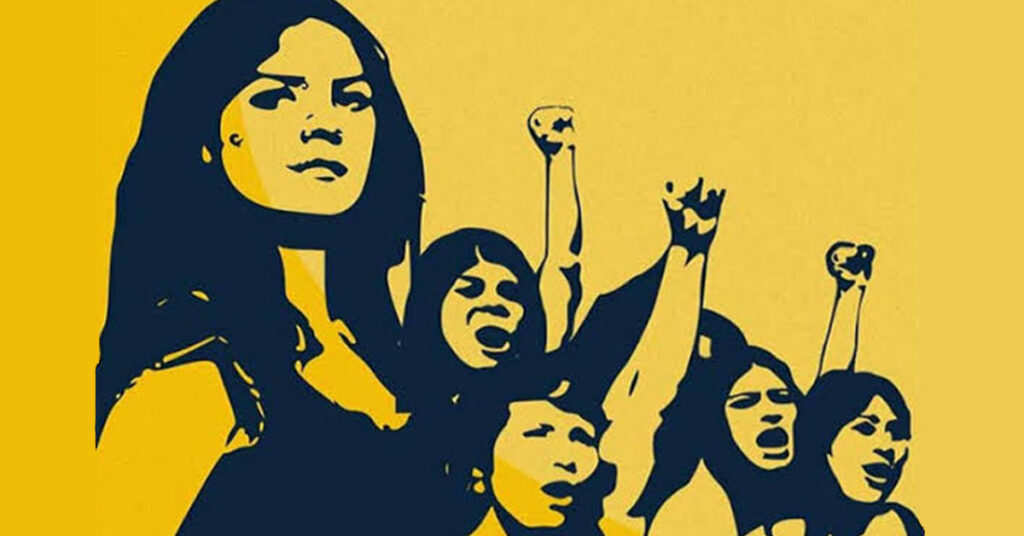
“A woman with a voice is by definition a strong woman. But the search to find that voice can be remarkably difficult” – Melinda Gates
The value of the labour of women has historically been underappreciated in India-be it in the domestic sphere or otherwise. Perhaps this underappreciation is why women’s participation in the Indian workforce today is severely lacking. On the Global Gender Gap Index by the World Economic Forum (WEF), India has fallen four places from 2018, now ranking 112 of 153 countries, largely due to its economic gender gap. Female participation rates declined from 34.1% in 1990-00 to 27.2% in 2011-12) and further down to 20.5 percent in 2019.

While the universal data is discouraging, examining the demographic divisions of this data might provide some explanations. Expectedly, there are considerable variations between urban and rural areas. The participation rates of rural women decreased from 26.5% in 2009-20 to 23.5% in 2011-12 while the rate for urban women increased from 14.6% to 15.5% during the same period. The size of agricultural landholdings has shrunk with concomitant divisions within families causing fewer agricultural work opportunities are partly responsible for this decline in the rural case. Moreover, male members of the family are given preference over female members during land inheriting, despite provisions such as the Hindu Succession(Amendment) Act, 2005.
The other aspect is education. Secondary education has increased which may account for the withdrawal of women of secondary school-going age from the informal sector labour force. The few paid, formal jobs available, besides MGNREGS in rural India, tend to go to men and women with degrees, leaving women educated only till the secondary school level in limb, even with skills that qualify them for non-agricultural work. For women past secondary school-going age, the workforce population has increased for urban women, while it has declined for rural women, reflecting the greater availability of formal jobs in urban areas.
The urban-rural angle is not the only consideration to be taken. Women with no education and women with tertiary education display the highest rates of labour force participation among Indian women. It can be argued that the rising incomes of Indian households have led Indian women to withdraw from the labour market and focus on their role in ‘status production’ i.e. domestic and caregiving activities that are considered the “natural and morally correct” duty of Indian women.
The societal importance placed on marriage over career for Indian women is another cause behind these figures. Marriage is still looked up as a source of social dignity, economic dependence. Because of this, women who choose to marry after becoming successful in the professional arena are less in number.

A survey in the Economic and Political Weekly in 2016 finds that around 40-60 percent of women and men in rural and urban parts of India believe that married women whose husbands earn a good living should not work outside the home. A survey by Avtar Group, a diversity and inclusion consulting firm, finds that women are paid 34 percent less than men for the same job with the same qualifications, despite India’s Equal Remuneration Act of 1976 that mandates equal pay for the same work and prohibits hiring discrimination.
Besides that Indian women are also obliged to well-meaning but discriminatory government policies like amended India’s Maternity Benefit Act 2017, which increased women’s paid maternity leave from 12 weeks to 26 weeks. This act reinforces women’s role as primary caregivers and increases employer bias, especially in the absence of similar benefits for fathers. Moreover, a significant amount of women’s work is not accounted for. On average, Indian women perform nearly six hours of unpaid work each day, while men spend a paltry 52 minutes.
The COVID-19 pandemic has only worsened the scenario. Surveys show that women have lost more jobs as compared to their male counterparts. In terms of the total population, 23.3 percent of men employees were laid off, as compared to 26.3 percent of women. According to Ms. Neetu Ahuja, Senior VP, Public Policy and Govt Affairs, Kotak Mahindra Bank, one in three mothers have considered leaving the workforce during the pandemic, this, of course, includes women in top leadership positions. Representation of women CEOs & MD in Indian listed companies today already stands at only 3.7% despite companies with women in executive positions reportedly having 50% higher profitability & share performance
Studies have shown that the financial performance of firms improves with more gender-equal corporate boards. The bottom half of the countries in terms of gender inequality in their sample could increase their GDP by an average of 35% if they close their gender gap. However, India is falling behind to reap the benefits of increasing the labour force participation of women.

To improve parity between gender in the labour force, as stated by Ms. Neetu Ahuja, wee need “Strong enablers such as favourable social support systems, flexible working hours, reservation in higher premier education institutions, reserved cabinet positions at Centre & State, not just in the parliament or assembly and increase in corporate boards positions.” Surveys have also found that the construction of either a kutcha or a pucca road increased the odds of women’s participation in non-farm work by 1.5 and 1.4 times. This highlights an urgent need to reduce occupation segregation and increase good and equal policies and awareness.
The road to having a voice in decision making is indeed tough, but once it starts it becomes a remarkable process because “empowered women, empower women”
and soon enough, an empowered society!
Arranged By Jaya Narayan
