
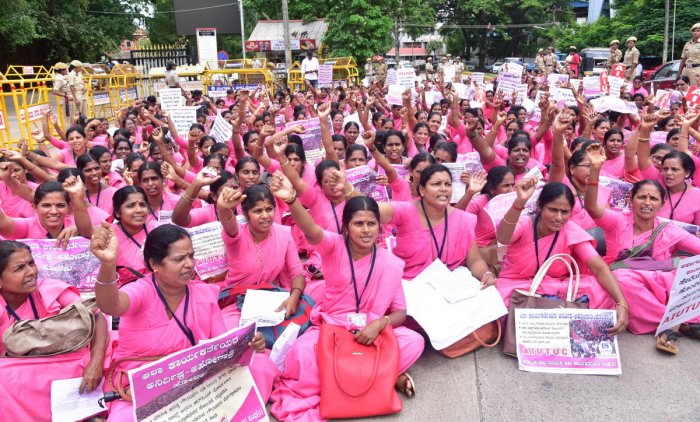
Along with the disruption of the healthcare ecosystem of India completely, the COVID -19 pandemic has exacerbated the deeply entrenched socio-economic problems of the country. The biomedical pandemic has undoubtedly turned into an endemic- of extreme unemployment, food insecurity and the unending plight of the frontline workers. Talking of frontline healthcare workers, the approx. 10 lakh ASHA workers in India are spearheading the COVID-19 identification and community awareness programme on foot. From conducting door-to-door surveillance to ensure the uptake of social distancing measures to busting myths around COVID-19, they have made sacrifices that no other can, in these times of tribulation. When the healthcare system of the country is creaking under the weight of this health crisis- these ASHA workers are soldiering on- continuing their thankless job, unarmed and unprotected.
For every health scheme launched by the Ministry of Health and Family Welfare, it is these women who step in to implement it at the grassroots level. From distributing iron tablets to checking on immunisation schedules of babies and pregnant women to carrying out periodic checks on TB patients, their job has expanded now to watching out for signs of COVID-19 and counselling people. In addition, they also have to look after the persons in quarantine and check whether they have completed it properly. They also periodically disseminate pandemic precaution tips to the public.

Renuka Renukegoudar, an anganwadi worker from Karnataka’s Belagavi district, to the The Hindu, expressed that only the ASHA and anganwadi workers do the difficult work of door-to-door surveys, detecting positive cases, tracing primary and secondary contacts, patrolling containment zones, and distributing food and medicines. According to her, even though rules specify that doctors and paramedical staff have to also do the rounds in containment zones, nobody ever turns up.
In Delhi, ASHA workers also form an important part of the medical supply chain, especially for expecting mothers, and have been assigned the responsibility of taking medicines from the dispensary and dropping it off at patients’ doorsteps when needed.
Their dedication towards community service can also be measured from the fact that during July in a major exercise, 1.6 lakh ASHAs tracked in two phases over 30.43 lakh migrants who returned to Uttar Pradesh during the COVID-19 lockdown and assisted the state government in contact tracing and community surveillance.
All of this work by the COVID – 19 ASHA workers is in addition to their already exemplary contribution in the non-COVID essential services. They have also been instrumental in providing RMNCH services which were directly affected by the lockdown measures and the necessity of maintaining physical distancing, according to the Union Health Ministry. The ASHAs have created awareness about the availability of these services and helped people to access them, it added.
Despite the truckload of work done by them, the challenges faced by them and their plight cannot be ignored. ASHA workers at various
districts are provided with minimal protective gears and few bottles of sanitizers – alongside, the ASHA Workers are poorly paid for their services increasing the burden over their shoulder. Many a time, the protective gears provided are torn, or are unusable forcing them to use their own dupattas or pallus to cover their nose and mouth while executing their duties. The ASHA Workers are also at the high risk of contracting the virus themselves – and risk the health of their own family members. Many of the workers have themselves tested positive for the virus sheerly because of the lack of enough protective gear, masks or sanitizers.

With the intensification of the nature of their work, which also included the screening of migrant workers, and gathering information and conducting surveys, the workers are facing frontline burnouts, however, with zero breaks or off workdays. Apart from the general lack of proper management, the ASHA workers are also facing mistreatment and manhandling by the male members of the society. At some reported instances,it has been seen the workers are either barred from entry, or are verbally abused by the family members. They’re shamed for their castes, and for their gender. They’re disrespected for the nature of their works, and yet they receive no protection and or justice. At the end, the ASHA workers are conducting their duties for the benefit of the community and the society, and in return is expecting coordination from the society.
When Hippocrats quoted, “let food be thy medicine and medicine be thy food”, the great Greek Physician, often considered the “Father of Medicine”, wished to bring forth and highlight the importance of our health and the necessity of upkeeping it. However, India, the second most
populous country in the world sheltering a substantial number of women and children, still lacks in extending proper medical facilities to a majority of the population in which the women and children are the most discriminated.
An ASHA Worker is the first port of call for any health related service required and thus, it is the primary duty of the nation, and the government to ensure that all of their needs are met, and they are allowed to live their life with respect and dignity for their selfless service to the nation.
REFERENCES:
https://thewire.in/rights/asha-workers-coronavirus
