
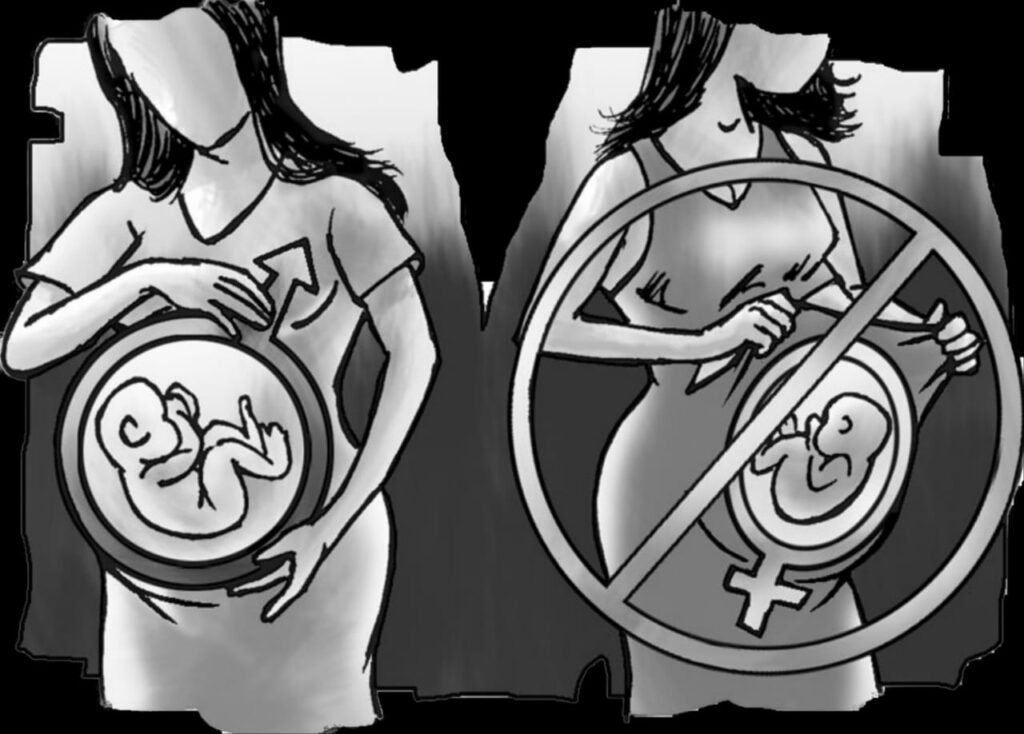
” Nowhere can you find a place as safe as this – said God to her. Next day, she was killed in her mother’s womb”.
As we celebrate Women’s Day this 8th of March, it is pertinent to acknowledge the ills that are relentlessly carried out against women in the society. It is only after rising above these nefarious evils, that we can hope for creating a safer and better society for our women. Female Foeticide is one such evil that needs to be rooted out.
Female foeticide is the selective abortion of female foetuses outside legal methods. It is killing one million females in India annually with far-ranging and tragic consequences. In some areas, the sex ratio of females to males has dropped to less than 8000:1000.
Female foeticide is a symptom of an underlying malady. Its incidence is increasing as families perceive that bearing daughters does not make economic sense and does not provide any social advantages. Added to that is generations of bias that favours bearing a male child.
MAJOR DEMOGRAPHICS AND STATISTICAL ANALYSIS

According to the Indian government, 10 million girls have been killed, either before or immediately after birth, by their parents over the past couple of decades despite a law that the government enacted that bans scan tests forecasting the sex of the baby in the womb. The United Nations says an estimated 2,000 unborn girls are illegally aborted every day in India. Now is the time to energize efforts to put gender equality at the top of international peace and development agenda.
However, doubts are bound to be raised on the effectiveness of the legislation as the issue mainly relates to people’s attitudes and preferences. The desire for a son, for instance, is deep-rooted in both rural and urban areas. The problem of dowry and the choice of a son for social security have also contributed to the malady. However, these have led to serious gender discrimination and adverse demographic implications in many states. For instance, according to an estimate, parts of Haryana have witnessed a dip in sex ratio — 618 girls for 1,000 boys. On the whole, while the national sex ratio is 933 per 1,000 men, in Haryana, Punjab, Chandigarh and Delhi, it is below 900. This shows that the menace has reached alarming proportions even in urban areas.

Amongst the states, the northern state of Punjab tops the list in number of female foeticide cases reported over the last three years with Rajasthan coming next. The country as a whole reported 294 cases during the same period. According to figures released by the National Crime Records Bureau in Punjab, 81 cases were registered for female foeticide while for Rajasthan the corresponding number was 51. Madhya Pradesh registered 21 cases, Haryana 18 and Chattisgarh 24.In Rajasthan, the number of cases registered has shown a steady decline since the last three years with 25, 16 and 10 cases being registered in 2006, 2007 and 2008. The National Capital saw seven cases registered in 2006, four in 2007 and two in 2008. A medical expert in India says that an estimated 80,000 women die from legal abortions on an annual basis.
CONTEXTUAL BACKGROUND
The bias against females in India is grounded in cultural, economic and religious roots. Sons are expected to work in the fields, provide greater income and look after parents in old age. In this way, sons are looked upon as a type of insurance. In addition, in a patriarchal society, sons are responsible for the “preservation” of the family name. Also, as per Hindu belief, lighting the funeral pyre by a son is considered necessary for the salvation of the spirit. This strong preference for sons which results in a life-endangering deprivation of daughters.
The birth of a son is regarded as essential in Hinduism and many prayers and lavish offerings are made in temples in the hope of having a male child. Modern medical technology is used in the service of this religion-driven devaluing of women and girls.
TECHNOLOGY
Women and Developments in Reproductive Technology Abortion was legalized in India in 1971 to strengthen humanitarian values (pregnancy can be aborted if it is a result of sexual assault, contraceptive failure, if the baby would be severely handicapped, or if the mother is incapable of bearing a healthy child). Amniocentesis was introduced in 1975 to detect foetal abnormalities but it soon began to be used for determining the sex of the baby. Ultrasound scanning, being a non-invasive technique, quickly gained popularity and is now available in some of the most remote rural areas. Both techniques are now being used for sex determination with the intention of abortion if the foetus turns out to be female. These methods do not involve manipulation of genetic material to select the sex of a baby.

Today, amniocentesis, which allows identification of sex in utero, has led to abortion of unwanted female fetuses. The incidence of this practice is revealed by the presence of an adverse sex ratio in many states. Amniocentesis was developed to detect genetic abnormalities, and the process is associated with the risk of miscarriage, septicemia, misinterpretation of results, and maternal death. While pregnancy may be legally terminated in India up to 12 weeks’ gestation, amniocentesis takes place at 16 weeks. It is difficult, if not impossible, however, to prove that parents are guilty of female feticide. In some states, parents who can not afford amniocentesis are continuing the practice of female infanticide.
WAY FORWARD
The Indian government should act immediately to control female feticide. Amniocentesis should take place only within government-run institutions, and the sex of the child should never be revealed to parents. A massive educational effort will be required to modify belief that it is only sons who can make necessary offerings after the death of a parent.
More than 50 yrs of independence, it is still a women’s face we see when we speak of poverty, of HIV/AIDS, of violent conflicts and social upheaval.
Therefore there is need of awareness amongst people from all walks of life and enlightening them with education are two foolproof tools of combating this ever pervading menace which has plagued our country and rendered the sex ratio to fall drastically.
Let us assert once again that each women and girl is a unique and at the same time valuable human being, who is entitled to equal opportunities and universally adopted human rights, no matter where she is born or where she lives.
REFERENCES
- www.merinews.com , Female infanticide: Stop barbaric practice on Thursday, February 28, 2008 by Prashant Mukherjee
- ‘Punjab tops in number of female foeticide cases’ New Delhi, Dec 15 (PTI)
- ‘Steven Ertelt’, LifeNews.com ,Editor, December 20, 2007
- The Medical Termination of Pregnancy Act, 1971
- Census of India, 2011
- https://timesofindia.indiatimes.com/readersblog/rightpath/female-foeticide-2780/
- “Female foeticide. A danger to society”. G B Kaur. Nurs J India. 1996 Apr.
