
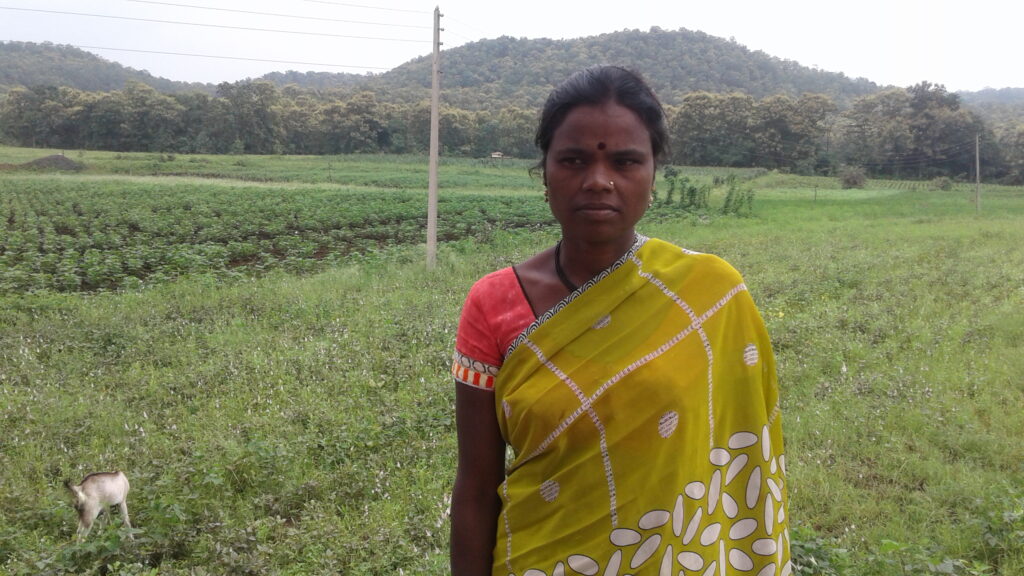
Women farmers show the way to healthy agricultural practices
By Nitin Jugran Bahuguna
CHHINDWARA DISTRICT (MADHYA PRADESH): When it comes to agriculture, Parmila Ivnati,
30, has diligently followed the practices handed down by generations of farmers in her family, trusting to
the old and tried ways of cultivation. When a new concept of growing cotton organically was introduced
in her district a few years back, like many of her fellow farmers she was skeptical. With great reluctance
she experimented with this new method on a small patch of land last year.
The results were beyond her expectations. Her profits were one hundred per cent as she didn’t have to
spend precious money on costly pesticides and fertilizers. The same was not the case for the cotton she
grew the traditional way. “I got two and a half quintals of cotton from the plants I sowed in about three
acres of land last year. I sold this for Rs 10,000 at the rate of Rs 4,000 per quintal. But my profit margin
was not much as I spent nearly Rs 2,000 on hybrid cotton seeds and even more than that on chemical
fertilizers and sprays,” discloses the young farmer who hails from Gajandoh village in Chhindwara
district.
Experimenting the organic way, however, she saved on medicines by preparing organic manure,
insecticides and pesticides using locally available material. “Earlier, my spacing of the cotton saplings
was not precise and I would just spread them out on my land. Now I know the importance of spacing the
saplings at a distance of three-by-three feet which is called ‘space marking’ and to grow another crop
along with the cotton plant in order to make the plant stronger as well as to give myself an additional crop
in the same area,” she adds.
Bharati Ivnati, 40, of the same village, has been growing cotton on her seven acres of land for several
years now. Convincing her to abandon traditional farming practices was not easy, but when she saw the
returns of the organic cotton crop she had reluctantly experimented with on a small patch of land, she was
convinced.
“I prepared one acre of land last year by applying chemical-free fertilizers as advised. I also learnt how to
make organic manure, insecticides and pesticides using locally available material,” says Bharati. “Earlier,
I used harmful and strong chemical pesticides for spraying which affected my health. I would also
indiscriminately use the sprays, not realizing that frequent spraying was not good for the plants.”
The practice of planting another crop alongside the cotton sapling is called inter-cropping and is one of
the salient features of the Organic Cotton Project, the first of its kind to be launched in India by
Worldwide Fund for Nature – India (WWF-India) with support from C & A Foundation, a Swiss-based
corporate foundation, and SRIJAN, a national NGO, in Chhindwara district in 2015-16.
A total of 128 villages have been covered under the project so far and 6000 farmers are registered.
Trainings and demonstrations on adopting improved agronomic practices, soil and water conservation
techniques, inter-cropping, pest and disease management and cotton quality and marketing are regularly
held for the farmers at meetings conducted in their respective villages.
“Sustainable agriculture plays an important role in conservation. It is an important piece of the puzzle.
When farmers manage their land sustainably, they can help preserve critical habitats by improving soil
and water quality,” says Dr. Sejal Worah, Programme Director, WWF- India.
The operative word being ‘organic’, the project emphasizes the need to replace destructive chemical
pesticides and fertilizers with environmentally-friendly manures and sprays. As more and more farmers
adopt these new techniques, the results have been dramatic and instant. “Since I started applying cow
dung as manure for my land and cow urine for spraying against pest attacks on my cotton saplings, I have
noticed a great change in my health. I no longer suffer from burning sensation in my eyes or itchiness and
boils on my skin,” reveals Parmila.
Situated in central India, Chhindwara district is home to two of the country’s oldest nature reserves – The
Pench Tiger Reserve and the Satpuda Tiger Reserve – famous for their untouched biodiversity and the
habitat of the iconic Bengal tiger. In between the two reserves live thousands of small cotton farmers like
Parmila and Bharati who are playing a key role in preserving the fauna and flora of the area by taking up
organic cotton farming.
The economic gains have also been significant. As the cotton farmers rely less and less on costly chemical
pesticides and fertilizers purchased at local markets, often with ill-advised counsel from the sellers on
their usage, they realize they have cut down tremendously on input costs.
Bharati admits that she only harvested about one quintal of cotton from the sole acre she devoted to cotton
crop and sold it for Rs 5,000. “But my profit margin was one hundred per cent as I did not incur any
production costs,’ she maintains proudly. In addition, the red gram she had planted as an inter- crop was a
blessing as it provided more than enough food for her household’s consumption. “I got two quintals of
red gram, more than sufficient for my family’s needs and sold one quintal for Rs 4,000.” END
