
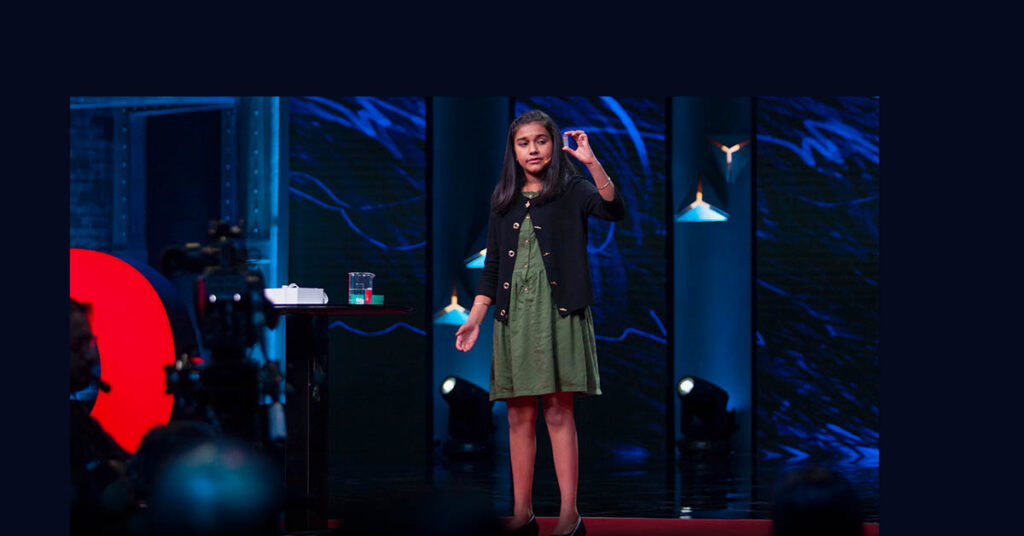
“In our minds, superheroes can jump tall buildings, have technological gadgets and superpowers. But what do they have in common — the ability to save lives. And the magical thing is that they show up exactly at the right time to save a life. How are living, breathing scientists different from the superheroes in comics?”
These wise words do not belong to any 40 year old scientist but to a 15 year old young scientist who looks nothing like the image one has, of an innovator and scientist.

The 15 year old is none other than Indian-American Colorado resident, Gitanjali Rao who is synonymous with breaking into bastions which have so far been ruled by grown-ups. The feathers that America’s Top Young Scientist (2017) has added to her cap, in the recent few years include winning the Discovery Education 3M Young Scientist Challenge in 2017, being an active STEM(science, technology, engineering, and mathematics) promoter, when she invented Tethys, a device that detects lead contamination in water, in 2017 and being featured on Forbes 30 Under 30 for her innovations. Gitanjali was also awarded the Top “Health” Pillar Prize for the TCS Ignite Innovation Student Challenge in May 2019 for developing a diagnostic tool called Epione based on advances in genetic engineering for early diagnosis of prescription opioid addiction.
With such rich achievements, Gitanjali created ripples in the world of science and turned heads by becoming the first youngster to be featured on the cover of TIME magazine and named their first “Kid of the Year” as the TIME Top young innovator in 2020.
Nothing short of a child prodigy, Gitanjali’s precocious streaks were evident to her parents when as a three year old, she asked her mother what she could do to help someone who was sick. It is this altruistic streak and the need to fix a problem, spurred by the deep interest in science has shaped Gitanjali into who she is today.
As a seventh grader, the young scientist’s preoccupation was trying to crack the problem of Flint crisis where the city’s water was contaminated with lead.
What keeps Gitanjali on her toes mentally is her love for science which is evident where she says, “‘No matter where they are, scientists come up with solutions to help people. I love science and I want to be a scientist superhero solving real world problems and saving lives.”
Apart from environment, Gitanjali’s thoughtfulness is visible in her contribution to solve the menace of cyberbullying at its early stages via an app, Kindly which is based on AI technology.

Says Gitanjali, “I started to hard-code in some words that could be considered bullying, and then my engine took those words and identified words that are similar. You type in a word or phrase, and it’s able to pick it up if it’s bullying, and it gives you the option to edit it or send it the way it is. The goal is not to punish. As a teenager, I know teenagers tend to lash out sometimes. Instead, it gives you the chance to rethink what you’re saying so that you know what to do next time around.”
But she isn’t all work and no play. She is an accomplished pianist and proficient in playing the piano, Indian classical dancing and singing, swimming, and fencing. She was nine years old when she began to learn classical music.
She is currently a member of Scouts and has enrolled in the Scouting STEM program in the United States,and is working on getting her pilot’s license
The latest engagements that keep her busy these days is that she is researching at the University of Colorado, Denver in the Department of Cell Biology to find a solution for prescription opioid addiction using the latest in genetic engineering and created a colorimetry based app and device. She is also excited about creating a community of young innovators wherein she identifies innovation as a necessity and not as merely a choice.
