
This is a man’s world,
this is a man’s world
But it wouldn’t be nothing,
nothing without a woman or a girl
Famous lyrics of the track by James Brown and The Famous Flames- the year was 1966 and America was gripped by the second wave of feminism where demands by fiery women were gaining credence for gender equality. This was a time for stronger steps towards gender equality after the first wave of feminism in 1848 which had fought for equal voting rights for women in America.
But in India, the waves of feminism came at its own pace. Ravaged by a colonial past, India had a lot on its plate and its women were still struggling to receive education post 1947. For Indian women in the freshly minted independent Bharat, it was a distant dream to gain access to information about their foreign fairer sex counterparts who were fighting tooth and nail for equal rights. Ones who despite being dismissed as bra burning feminists, were burning a path for women to tread on and shatter the invisible glass ceilings that had limited them for eons.

India almost resembles a schizophrenic dream. A country with starkly contrasting ethos. On one hand the land that celebrates the tradition of Kanya poojan which literally translates to the worship of a girl-child on a prefixed auspicious day and on the other hand the concept of Kanya-daan which has been the soul of every Indian wedding. Kanya-daan is a tradition where the bride’s father (or if he is not alive, the eldest male member of the family and not any female member) ‘gives-away’ his daughter to the groom’s family, thereby reducing the daughter’s stature to that of a commodity. Recently a wedding hit the headlines when a single mother performed the Kanya-daan for her daughter and broke the bastion which had been held exclusively by men for ages. It was reported that the mother had ‘earned’ herself that place for having raised her daughter on her own. Why earned? Why do women have to always prove to the world that they rightly deserve a spot under the sun? Why cannot a mother rather than a father be the first choice for driving her child’s wedding forward. Hasn’t she borne the child for nine months and contributed nine months extra ?
For as long as we can remember, Indian weddings have been led predominantly by the men who have played the pivotal parts in driving the wedding ceremony forward and women have had marginalized roles. Restricted to being wall flowers that blend into the background without having much say except in culinary matters, women have mostly had to watch the men take control of the reins of the impending wedding preparations and only provide a touch of glamour to the big fat Indian weddings.
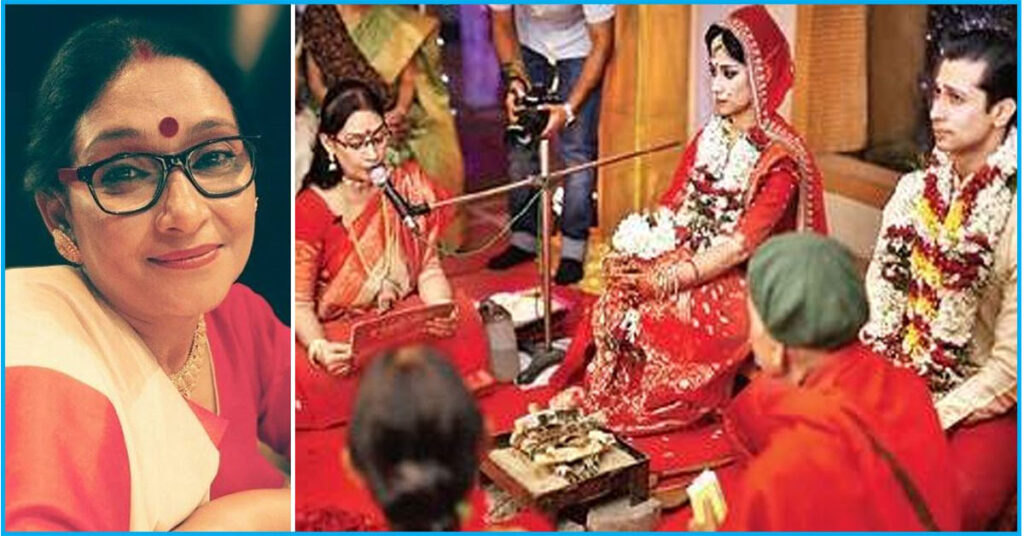
The hoary traditions are deeply enmeshed in every aspect of an Indian wedding and on top of that, Indians are very sentimental about the rituals, which have not been questioned through the generations so when some brave women stray from the norm and the deviation makes its presence felt, it turns heads. In the last few years, an unthinkable feature has gradually crept into the Indian weddings- the debut of female priests solemnizing the weddings instead of the ubiquitous male priest and the concept of Kanya-daan having been eliminated from many of these weddings altogether, where the bride has refused to be commodified.
Recently Diya Mirza’s wedding made waves when an elderly female priest solemnized her wedding instead of a male priest but it is neither the first nor will it be the last such wedding that has left a lasting impression on people for shattering patriarchy and establishing a level playing field for women who are finding their way into every such role that was once inconceivable for them.
This generation is letting its choices speak through symbolisms that are not just progressive but helpful in creating an egalitarian society. Weddings which were once an upholder of hackneyed traditions, are giving way to brides whose choices range from wearing pant-suit rather than a traditional lehenga on D-day, to adopting environmental friendly weddings, to replacing lavish weddings with court marriages to channelizing their gift-money to charity to doing away with dropping their surnames to accommodate their husband’s surnames.

Bengal has witnessed quite a few weddings solemnized by female priests who, instead of chanting the Sanskrit mantras which are often indecipherable, have replaced them with verses in Bengali that are easily understandable by everyone listening to it which in turn led to an attentive audience than the usual apathy and boredom which people find themselves in while attending weddings. A father of a bride had made news and twitterati hailed the wedding as lit, when he refused Kanya-daan by acknowledging that he did not want to treat his daughter as property owned by him.
It is heartening to see the change in a land that had soiled its karma by clocking maximum cases of female infanticide, child-marriages and oppression of widows, not to mention Sati where the wife had to volunteer herself to be burnt alive on her husband’s funeral pyre. To witness male priests being replaced in weddings, by high priestesses of knowledge and intellect who are bestowing their blessings on couples starting their lives on an equal footing is a seed of hope which may usher even bigger changes and we may soon witness weddings that will do away with other such rituals which are holding us back from treating each other fairly. As of now, the role of the priest has been defined by his caste but if we are truly aspiring for a caste free world, then after a female priest, it is time to have a Dalit or an adivasi priest solemnize weddings and then maybe, we can call ourselves a truly inclusive society that is gender-less and caste-less.
