A nation’s progress is measured not only by the strength of its economy, but by the power of education that shapes the future of its daughters. Educating a girl is often described as educating an entire generation, yet for millions of girls across India, access to education still remains a challenge.
Every classroom is meant to be a space of dreams, opportunity and empowerment, but for many young girls, education quietly pauses every month because of something as natural as menstruation and something as preventable as the lack of usable toilets. According to the recent NITI Aayog 2026, report on school education, nearly 98,592 schools across the country still lack functional girls’ toilets, while about 61,540 schools lack any usable toilet facilities at all and more than one lakh schools continue to function without electricity. Thousands of schools also remain without proper water supply and sanitation facilities. These figures expose a harsh reality that inadequate infrastructure continues to force many girls into absenteeism and school dropouts, particularly during menstruation. What should be recognised as a natural biological process continues to affect educational access and equal opportunities for countless students.
What should be treated as a basic health requirement often turns into silence and discomfort, forcing girls to miss classes and gradually affecting their continuity in education. Behind walls painted with promises of empowerment, thousands of girls continue to study without safe and functional sanitation facilities, carrying a burden that no child should have to bear while pursuing education.
In rural India, women and especially adolescent girls continue to face social isolation because of poor hygiene standards and the absence of proper sanitation facilities. Lack of access to clean and functional toilets not only affects physical health, but also restricts the mobility, confidence and participation of girls in schools and public spaces. Access to toilets, as has increasingly been observed, contributes significantly to the social growth, independence and educational continuity of women and girls.
For countless adolescent girls, education is interrupted by silence, stigma and the absence of dignity within school spaces. Societal taboos surrounding menstruation, family pressure, inadequate menstrual hygiene facilities and unsafe or unusable toilets often force girls to remain absent from classrooms repeatedly until many eventually discontinue their education altogether. In many schools, toilets may exist, yet the lack of water, cleanliness, maintenance and privacy makes them unfit for use, turning a basic necessity into a daily challenge for young girls.
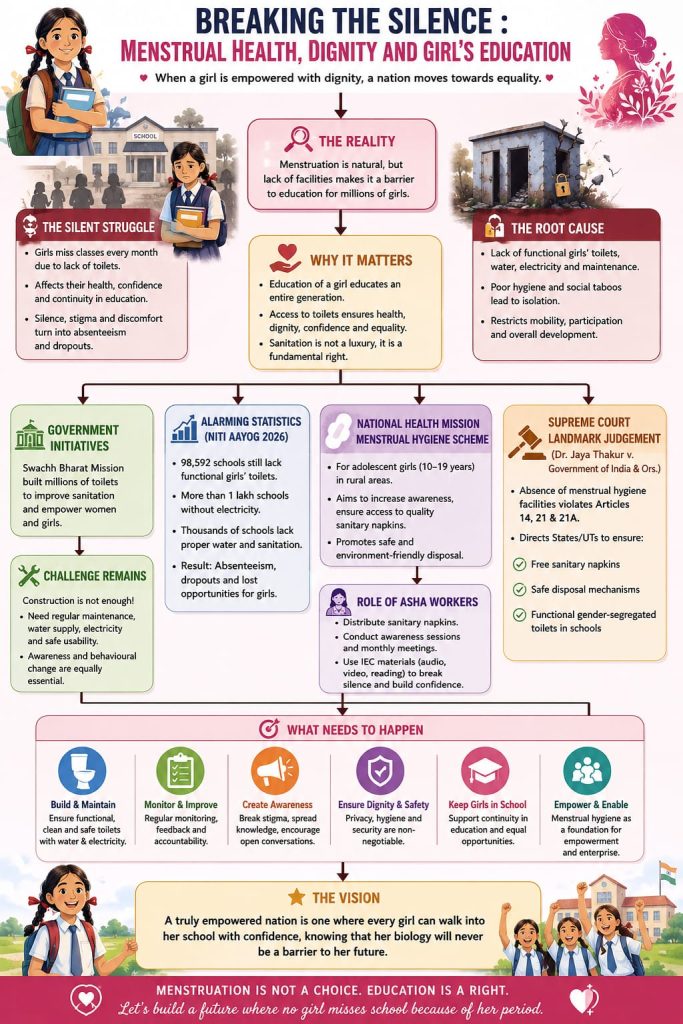
Recognising the importance of sanitation and hygiene, the Government of India over the past decade has focused on improving sanitation infrastructure under the Swachh Bharat Mission with the objective of strengthening health, dignity and educational access for women and girls. Under the Swachh Vidyalaya initiative launched in 2014 in alignment with Swachh Bharat Abhiyan, the Government prioritised the construction and restoration of school toilets across the country, including separate toilet facilities for girls. By 15th August 2015, nearly 4,17,796 toilets were constructed or made functional in 2,61,400 schools under the initiative. The campaign marked an important step towards addressing the long-neglected issue of sanitation accessibility and its direct connection with education, menstrual hygiene and women’s empowerment. However, the challenge today extends beyond construction alone and demands regular maintenance, availability of water supply and safe usability of facilities as well as increased awareness in this regard.
The issue of inadequate sanitation infrastructure in schools continues to directly affect girls’ education and attendance. Studies conducted by the Liverpool School of Tropical Medicine and UNICEF during 2014–15 observed that nearly 1/4th of school-going girls in India took leave during menstruation due to inadequate gender-specific toilets and the non-availability of sanitary pads in schools. UNICEF further emphasised that the availability of separate toilets and menstrual hygiene management facilities significantly helps reduce absenteeism and school dropouts among adolescent girls. These findings continue to reflect the serious infrastructural gaps affecting girls’ education, dignity and health across the country.
The Government of India has also introduced the National Health Mission Menstrual Hygiene Scheme for adolescent girls between the ages of 10 to 19 years in rural areas. The scheme aims to increase awareness regarding menstrual hygiene, improve access to quality sanitary napkins and ensure their safe disposal in an environmentally sustainable manner. Initially launched in 2011 across selected districts, the programme later expanded under the National Health Mission framework to support decentralised procurement and subsidised distribution of sanitary napkins among rural adolescent girls.
An important feature of the scheme is the role played by ASHA workers, who are responsible not only for distributing sanitary napkins but also for conducting awareness sessions and monthly meetings for adolescent girls at Anganwadi Centres and community platforms. Through information, education and communication materials including audio, video and reading resources, the scheme seeks to break silence surrounding menstruation and encourage safe and hygienic menstrual health practices among young girls in rural India.
In this backdrop, the landmark judgement of Supreme Court of India in Dr. Jaya Thakur v. Government of India & Ors. emerges as a transformative constitutional intervention. The Bench comprising Justices J.B. Pardiwala and R. Mahadevan held that the absence of menstrual hygiene facilities violates Articles 14, 21 and 21A of the Constitution. Recognising menstrual hygiene as essential to equality, health and education, the Court directed all states and union territories to ensure free sanitary napkins, safe disposal mechanisms and functional gender-segregated toilets in schools.
The judgement, however, must not remain confined to courtrooms and policy documents alone. The real need of the hour is effective implementation, regular monitoring and the maintenance of facilities that already exist but often remain unusable due to poor sanitation, lack of upkeep and inadequate accessibility. Building toilets alone is not enough if girls cannot use them with safety, privacy and comfort. Menstrual hygiene must be addressed as an essential requirement for equal access to education, empowerment and enterprise. The true success of this constitutional intervention will be measured not by statistics on paper, but by classrooms which are attended by many girls living in rural and remote areas with less access to transport, and sanitation facilities where no girl is forced to miss education because of menstruation. A truly empowered nation is one where every girl can walk into her school with confidence and the assurance that her biology will never become a barrier to her future.
The judgement carries a message far beyond legal compliance. Menstruation cannot become a barrier to education or opportunity. A nation aspiring towards inclusive development must ensure that no girl is compelled to choose between her education and her biology. True empowerment begins when classrooms become spaces not only of learning, but also of safety, inclusion and equal opportunity.