The GARBH-INi (Interdisciplinary Group for Advanced Research on Birth Outcomes – DBT India Initiative) is a flagship research programme supported by the Department of Biotechnology. It is dedicated to addressing preterm birth, a critical public health challenge that remains
one of the leading causes of neonatal mortality in India and accounts for nearly 25% of the global burden.
The programme adopts a comprehensive and interdisciplinary approach to improve birth outcomes. It integrates clinical research, advanced biological studies, and artificial intelligence-based tools to predict pregnancy-related risks. Additionally, it examines the influence of maternal health, environmental conditions, and postnatal factors on child growth and development.
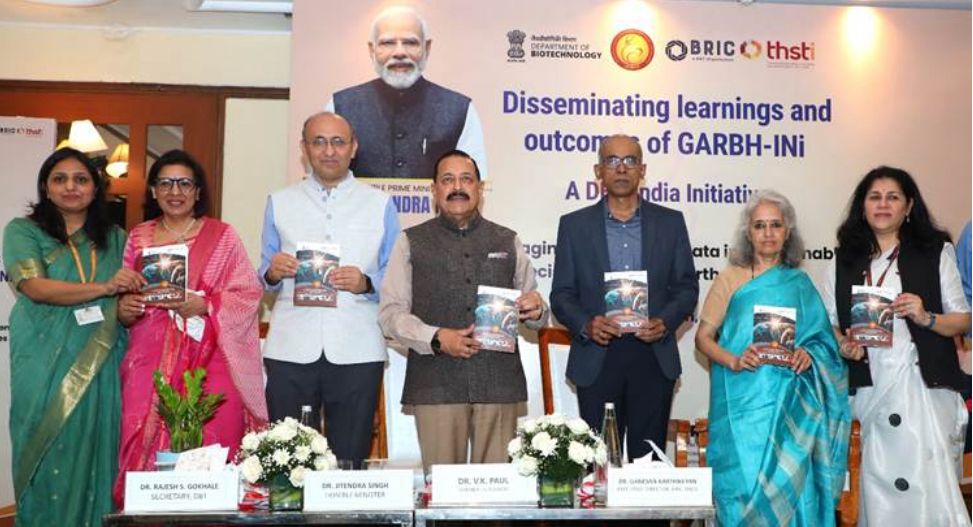
The significance of this initiative was highlighted during a commemorative event held on March 23, 2026, which was graced by Hon’ble Union Minister of State (Independent Charge), Science and Technology, Dr. Jitendra Singh, Secretary, Department of Biotechnology (DBT), Dr. Rajesh Gokhale, along with other senior Scientists and experts underscoring its national importance.
Key Initiatives and Research Efforts
Launched in 2015, GARBH-INi has studied approximately 12,000 pregnant women, making it one of the largest pregnancy cohort studies in South Asia. The programme has generated an extensive dataset, including biological samples and over one million ultrasound images and videos. To support long-term research, a national biorepository was established for systematic storage of biological samples. Furthermore, a dedicated datasharing platform, GARBH-INi-DRISHTI, was developed at the Translational
Health Science and Technology Institute, serving as a valuable national resource for researchers and policymakers.
Major Outcomes and Contributions
The programme has led to several significant breakthroughs: Development of more accurate pregnancy dating models specifically tailored
for Indian women, improving clinical decision-making and monitoring Identification of beneficial maternal microbiota and early detection tools fo assessing the risk of preterm birth. Generation of evidence emphasizing the need for context-specific healthcare solutions, rather than relying solely on Western medical models. These outcomes contribute to more cost-effective, relevant, and inclusive healthcare strategies for India.
Conclusion
GARBH-INi represents a significant step forward in India’s efforts to tackle maternal and neonatal health challenges. By combining scientific innovation with locally relevant research, the programme sets a benchmark for developing sustainable and impactful healthcare solutions tailored to the needs of the population